
They Laughed at Pat Buchanan. Now We Wander Among the Ruins of Their Empire.
The “respectable” right spent 30 years mocking the only man telling the truth. Today, we are choking on the reality he predicted.

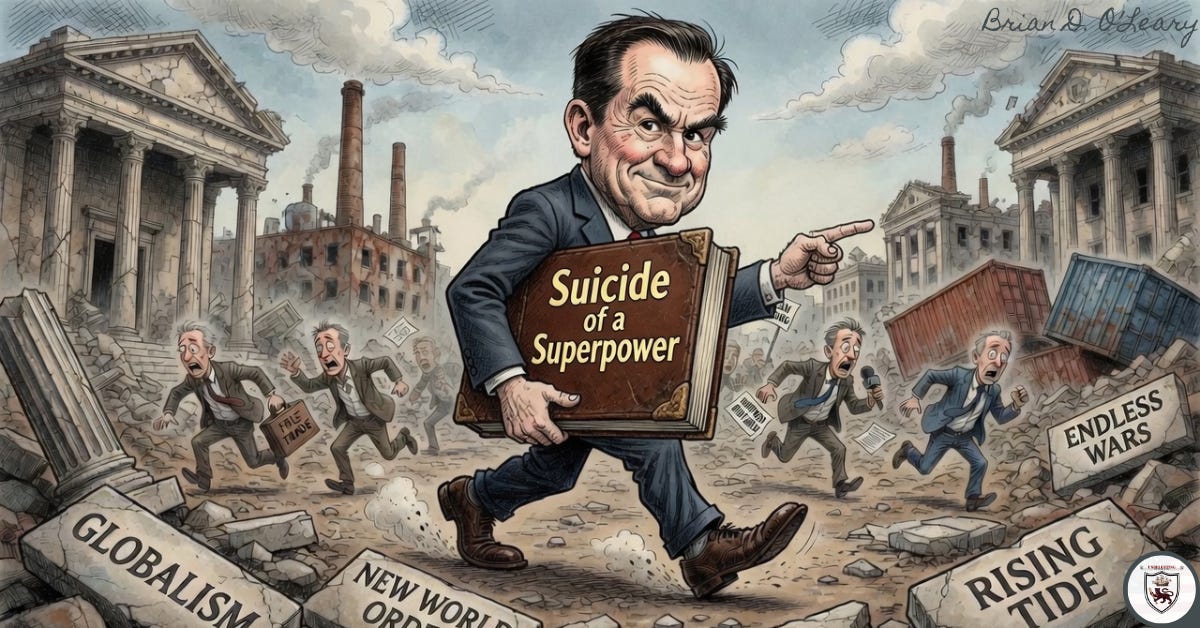
A 2015 segment from Hannity recently resurfaced on 𝕏. It compressed the entire failure of the modern right into a few minutes. Sean Hannity and Pat Buchanan locked horns over Iran. The host operated in his usual register. Breathless. High-decibel.
Hannity read from a script and framed every foreign dispute as a five-alarm fire. “Bibi has been warning us for years,” he repeated.
Yet, parroting the anxieties of an Israeli prime minister does not constitute a coherent American foreign policy.
Buchanan dismantled the charade without raising his voice. That’s the difference between serious statecraft and cable news. He relied on timeless conservative principles—in sharp contrast to the neoconservative itch for conflict we detailed last summer in The War Party Wants a Nuclear Catastrophe with Iran.
For decades, the political establishment has relied on this rhetorical end-around. They demand volume and sell panic, stoking apocalyptic fears to justify their next foreign intervention.
Buchanan, a senior advisor to three presidents, recognized Washington’s emotional fragility. Forged during his time with Richard Nixon in 1966, Buchanan’s political education gave him a grounded view of power that modern think-tankers lack.
When Nixon boarded the helicopter on the South Lawn for the final time, Buchanan became the only major figure capable of articulating what that political void meant to the Forgotten American. He did it without apology or the euphemisms preferred by the new class of political managers.
Buchanan announced on December 10, 1991, that he would challenge the sitting president in the upcoming Republican primaries.
“[Bush] is a globalist and we are nationalists. He believes in some Pax Universalis; we believe in the Old Republic. He would put America’s wealth and power at the service of some vague New World Order; we will put America first.”
Party insiders considered it a joke—until he captured 38 percent of the vote in New Hampshire and panicked the GOP brass.
Buchanan won over three million popular votes, forcing the president to shift right. The managerial class soon declared that the problem was the messenger, not the message, as historian Ryan Walters relates:
“But when Bush lost to Clinton ... the establishment didn’t wring their hands over the failures of Bush’s administration ... but laid the blame at Buchanan’s feet. Had he not challenged Bush ... independents and moderates would not have been frightened into Clinton’s camp and the President would have won another term.”
Court historians file away the Buchanan Brigades and the presidential campaigns of 1992, 1996, and 2000 as the personal failures of a three-time candidate. The elites cling to this fiction because the alternative is admitting those campaigns represented the country’s repeated refusal to choose the man who foretold the coming disaster.
Voters instead bought the establishment’s lie that the global economy would guarantee wealth for everyone. They traded traditional order for cheap consumer goods and offshore profits.
The media recoiled from Buchanan’s blunt address at the Republican National Convention, branding it the “Culture War Speech” to signal that Buchanan and the conflict he identified on that Astrodome stage were more dangerous than losing the country itself. He laid out the stakes without flinching:
“There is a religious war going on in this country.
It is a cultural war, as critical to the kind of nation we shall be as was the Cold War itself, for this war is for the soul of America.”
Buchanan refused to ignore the war, so the establishment blamed him for starting it.
Republicans spent the rest of the decade embracing open trade and open borders. Corporations and the political class hollowed out the American manufacturing base and shipped it overseas while the public watched.
In 1998’s The Great Betrayal, Buchanan dismantled the free-trade orthodoxy—a systematic selling-out of the American worker and the middle class that once sustained the republic. Just as his Houston speech diagnosed the nation’s moral decay, The Great Betrayal exposed the economic surrender.
To this day, the establishment refuses to admit that it sacrificed the nation for the global economy.
The electorate chose comfort over continuity—buying the illusion that a country is just an economic zone rather than a home. The establishment responded by caving to the latest cultural fads. They believed that complying with the rules of polite society was the key to political survival.
It was a slow-motion surrender.
The moment Suicide of a Superpower hit shelves in 2011, MSNBC pulled the trigger. Citing the book as a pretext, executives suspended Buchanan immediately and officially cut ties months later after declaring his ideas “inappropriate for national dialogue.”
The book’s central thesis was unforgiving: A nation is not a random assortment of individuals, but a distinct people bound by a shared language, common heroes, and a common faith.
Culture was only one front in this war. Buchanan warned that a nation that guts its industrial base will lose the very people who sustain it. The free-trade consensus of the 1990s and 2000s guaranteed that outcome, erasing more than 4.5 million manufacturing jobs and locking a growing share of the population into long-term dependency.
Suicide of a Superpower wasn’t a pure polemic. It was a critique of a dying culture and an analysis of an economic system that no longer served its people.
Buchanan’s prophecies require no defense today. The optimistic illusions of the 1990s are dead. They lie buried under the rubble of the America they left behind.
The sudden resurgence of Buchanan’s work isn’t nostalgia. We aren’t reminiscing over old baseball cards—we are watching a thirty-year fuse finally burn down. The media talking heads and the entrenched politicos, who spent decades laughing at him, today stumble through the wreckage of their own making.
The old guard wants you to keep looking away. But the echoes of Buchanan’s victory speech in New Hampshire ring just as loud today:
“Do not wait for orders from headquarters, mount up everybody and ride to the sound of the guns!”
The Prophets Were Right. Mount Up.
We’ve been doing a lot of “Nixonmaxxing” lately. Nixon and Buchanan shared the same trenches, but Buchanan was the one willing to name the cultural and national questions the operators preferred to leave unspoken.
What you are seeing across the American right today is pure Buchanan.
It’s time to saddle up. If you want the unvarnished, cold truth, subscribe today:
Join serious people who know what UNRELENTING looks like.
Even the ultimate Nixonmaxxer himself, Roger Stone (@RogerJStoneJr on 𝕏 and Roger Stone here on Substack), who served in the Nixon White House alongside Pat Buchanan, is a paid subscriber to our platform.
Stop letting the chattering class lie to you. It’s time to stand with the foremen willing to rip up the rotten floorboards.
Join Roger and a growing army of Forgotten Americans.
Subscribe now and get in the fight.